Go to Introduction
|| Baptism Bible Studies || Apostolic Water Baptism Index || Baptism Full Immersion || Baptism Whose Name? || Baptism Name Father, Son, Holy Spirit || Baptism Name Lord Jesus Christ || Baptized Into Name Father || Baptized into Name Lord Jesus || Baptized into One Body || Baptized into Jesus Christ || Baptized into His Death || Rebaptism: When? || Repent and First Works ||
#4. WATER BAPTISM IN THE NAME OF THE LORD JESUS CHRIST
Search this website || Bible Studies Index
This bible study uses a Greek Unicode font and is printer friendly.
Greek Word Study βαπτίζω baptizo baptize.
Greek Word Study βάπτισμα
baptizma baptism.
- Baptism Study Index
- YOUTUBE VIDEO 4 Baptisms In the River Severn 15/8/2018 - 7 Mins
- Introduction 4
- #4.1 Baptism "in the name" of Jesus Christ (Acts 2:38) (Greek: ἐπὶ τῷ ὀνόματι)
- #4.2 Baptism "in the name" of the Lord (Acts 10:48) (Gr. ἐν τῷ ὀνόματι)
- #4.3 Baptism "in the name" of the Lord Jesus (Colossians 3:17) (Gr. ἐν ὀνόματι)
- #4.4 Baptism "in the name" of the Lord Jesus (Acts 8:16; 19:5) (Gr. εἰς τὸ ὄνομα)
- #4.5 Conclusion: Baptism "in the name of the Lord Jesus Christ"
- #4.6 What about Variations of this?
Introduction 4
In spite of the apparent instruction of Jesus to baptize new converts "in the name of the Father, and of the Son, and of the Holy Spirit" (Matthew 28:19), the apostles never did it. This is a rightly divided bible study showing how how the apostles water-baptized in the name of the Lord Jesus Christ. Look at these scriptures:
(Acts 2:38) "Then Peter said to them, Repent, and be baptized every one of you in the name of Jesus Christ for the remission of sins, and you will receive the gift of the Holy Spirit."
(Acts 8:14-16) "Now when the apostles who were at Jerusalem heard that Samaria had received the word of God, they sent Peter and John to them:
15 Who, when they came down, prayed for them, that they might receive the Holy Spirit:
16 (For as yet he was fallen upon none of them: only they were baptized in the name of the Lord Jesus.)"
(Acts 10:47-48 Peter) "Can any man forbid water, that these should not be baptized, who have received the Holy Spirit as well as us?
48 And he commanded them to be baptized in the name of the Lord. Then they asked him to stay a few days."
(Acts 19:4-5) "Then Paul said, John indeed baptized with the baptism of repentance, saying to the people, that they should believe in him who would come after him, that is, on Christ Jesus.
5 When they heard this, they were baptized in the name of the Lord Jesus."
(Colossians 3:17 Paul) "And whatever you do in word or deed, do all in the name of the Lord Jesus, giving thanks to God and the Father by him."
These are all of the scriptures which refer to "the name" that the apostles used, or could have used when referring to water baptism. The words translated "of Jesus Christ" (Acts 2:38), "of the Lord" (Acts 10:48), and "of the Lord Jesus" (Acts 8:16; 19:5; Colossians 3:17), are all in the genitive case in the Greek. This shows uniformly that Christ is the possessor of the name, and there need be no confusion about this. However, the key words that need to be analyzed here are those translated "in the name", because here the construction in the Greek is slightly different in each case, which enables a more detailed analysis to be made, and thus a more accurate understanding to be obtained.
#4.1 Baptism in the name of Jesus Christ (Acts 2:38) (Greek: ἐπὶ τῷ ὀνόματι)
| Greek - Acts 2:38 - English | |
|---|---|
| Πέτρος δὲ ἔφη πρὸς αὐτούς Μετανοήσατε καὶ βαπτισθήτω ἕκαστος ὑμῶν ἐπὶ τῷ ὀνόματι Ἰησοῦ Χριστοῦ εἰς ἄφεσιν ἁμαρτιῶν καὶ λήψεσθε τὴν δωρεὰν τοῦ ἁγίου πνεύματος | 38 Then Peter said to them, Repent, and be baptized every one of you in the name of Jesus Christ for the remission of sins, and you will receive the gift of the Holy Spirit. |
τῷ ὀνόματι (Gtr. tō onamati) is the dative case in the Greek, and although the
dative has several different uses, it is the instrumental case, and is used whenever it is required to express the means by which something is carried out
(WP p112; DFH p69; JWW p69).
What Peter meant here, was that "the name of Jesus Christ" was one of the instruments to be used when people are baptized. Another instrument would be
water (Luke 3:16) where the same dative case is used, but without a preposition. Compare other scriptures where we can do something
ἐπὶ τῷ ὀνόματι (in the name) of Jesus. These are; receive a little child (Matthew 18:5; Mark 9:37; Luke 9:48),
come (Matthew 24:5; Mark 13:6; Luke 21:8), work a miracle (Mark 9:39), cast out demons (Luke 9:49), preach (Luke 24:37), speak (Acts 4:17; 4:18; 5:40), and teach (Acts
4:18; 5:28). All these things we can do using the name of Jesus, and on the authority of the name of Jesus, which all show that it is correct to use the
name of Jesus Christ when we baptize also. There are some scriptures which leave little doubt that ἐπὶ τῷ ὀνόματι can mean "using the
name":
(Matthew 24:5) "many shall come in my name, saying, I am Christ; and shall deceive many."
(Mark 13:6) "many shall come in my name, saying, I am Christ; and shall deceive many."
(Luke 21:8) "many shall come in my name, saying, I am Christ."
In each of these cases "in my name" is translated from the Greek ἐπὶ τῷ ὀνόματί μου (Gtr. epi to onomati mou),
which literally reads "in the name of me". These are false Christs who will deceive many (Matthew 24:5; Mark 13:6), so we can eliminate the fact that
they come in Christ's character, or in his authority. This leaves one logical interpretation; they come "using his name", saying, "I am Christ".
Another example:
(Luke 1:59) "they called him Zacharias, after the name of his father."
This refers to the baby John the Baptist, where the words "after the name" (Gr. ἐπὶ τῷ ὀνόματι)
cannot refer to his father's authority, because when he was asked, he contradicted it (Luke 1:63). So here again, the Greek word
ἐπὶ (Gtr. epi) could mean "using", and being the instrumental case, the name
was spoken: "they called him Zacharias, using the name of his father."
So it is with baptism also, when Peter said, "be baptized in the name of Jesus Christ" (Acts 2:38), he meant using the name of Jesus Christ.
#4.2 Baptism "in the name" (Acts 10:48) (Gr. ἐν τῷ ὀνόματι)
| Greek - Acts 10:47-48 - English | |
|---|---|
| Μήτι τὸ ὕδωρ κωλῦσαί δύναται τις τοῦ μὴ βαπτισθῆναι τούτους οἵτινες τὸ πνεῦμα τὸ ἅγιον ἔλαβον καθὼς καὶ ἡμεῖς | 47 Can any man forbid water, that these should not be baptized, who have received the Holy Spirit as well as us? |
| προσέταξεν τε αὐτοὺς βαπτισθῆναι ἐν τῷ ὀνόματι τοῦ Κυρίου τότε ἠρώτησαν αὐτὸν ἐπιμεῖναι ἡμέρας τινάς | 48 And he commanded them to be baptized in the name of the Lord. Then they asked him to stay a few days. |
Note: The thing with which an act is done is called the INSTRUMENT, and is expressed in Greek by the dative case,
sometimes with the preposition ἐν, sometimes without it (DFH p69; WP p116).
The only difference between the expression ἐν τῷ ὀνόματι (Gtr. en to onamati) and the
previous one ἐπὶ τῷ ὀνόματι (Gtr. epi to onomati), is that the preposition ἐν is used instead of ἐπὶ.
While the most common translation of ἐπὶ with the dative case is "in" (53 times), the basic meaning of ἐν
is also "in", both having various other translations depending upon their uses. The preposition ἐν
is only ever used with the dative case (DFH p106; WP p114), and when used in an instrumental sense it could be translated "in" (John 14:14; Acts
16:18), or "by" (Romans 1:10; Acts 4:9; 7:35), or "with" (Luke 8:15; 22:49; John 1:26). It shows what is being used to perform a task. Look at
other things that we can do ἐν τῷ ὀνόματι (in the name) of Jesus. We can
ask for something from the Father in prayer (John 14:13; 14:14; 15:16; 16:23; James 5:14), cast out demons (Mark 9:38; 16:17; Luke 10:17), deliver someone to
Satan (1 Corinthians 5:4), preach (Acts 9:29), and heal the sick (Acts 3:6; 4:10). Again, in each of these cases we are using the name of Jesus, showing that we
should use the name of "the Lord" when we baptize also. It is significant that when the disciples forbade a man casting out demons in Jesus' name, he
was doing it in (ἐν) the name of Jesus according to Mark (Mark 9:38), and in (ἐπὶ) the name of Jesus according to Luke
(Luke 9:49). This shows the degree of similarity and interchangeability between the two prepositions ἐν
and ἐπὶ when used in an instrumental sense.
Other examples where ἐν with the dative case literally means using.
(Revelation 2:16) "I ... will fight against them using the sword of my mouth."
(Revelation 2:23) "And I will kill her children using death."
In these cases the Greek word ἐν is translated "with", but obviously also means "using".
#4.3 Baptism "in the name" (Colossians 3:17) (Gr. ἐν ὀνόματι)
| Greek - Colossians 3:17 - English | |
|---|---|
| καὶ πᾶν ὅ τι ἂν ποιῆτε ἐν λόγῳ ἢ ἐν ἔργῳ πάντα ἐν ὀνόματι κυρίου Ἰησοῦ εὐχαριστοῦντες τῷ θεῷ καὶ πατρὶ δι᾽ αὐτοῦ | 17 And whatever you do in word or deed, do all in the name of the Lord Jesus, giving thanks to God and the Father by him. |
Note: The means by which or with which the action of the verb is carried out is put into the dative case, often with the preposition ἐν, but sometimes without a preposition (WP p112, p116). Here, the difference between ἐν ὀνόματι and ἐν τῷ ὀνόματι (See #4.2), is just the absence of the definite article τῷ, equivalent to "the" in English. Often in New Testament Greek the article is omitted in the text, but is implied by the context. For example, see how wrong it would be to translate ἐν ὀνόματι literally as "in a name" (2 Thessalonians 3:6; Colossians 3:17; Ephesians 5:20), where the article is omitted in each case. In these cases, the omission of the article makes no difference to the meaning, so ἐν ὀνόματι here can also mean "in the name", and is thus the same as ἐν τῷ ὀνόματι (See #4.2). Being the dative, instrumental case, this scripture says that we should do all (including water baptism) using the name of the Lord Jesus.
#4.4 Baptism "in the name" (Acts 8:16; 19:5) (Gr. εἰς τὸ ὄνομα)
| Greek - Acts 8:14-16 - English | |
|---|---|
| Ἀκούσαντες δὲ οἱ ἐν Ἱεροσολύμοις ἀπόστολοι ὅτι δέδεκται ἡ Σαμάρεια τὸν λόγον τοῦ θεοῦ ἀπέστειλαν πρὸς αὐτοὺς τὸν Πέτρον καὶ Ἰωάννην | 14 Now when the apostles which were at Jerusalem heard that Samaria had received the word of God, they sent Peter and John to them: |
| οἵτινες καταβάντες προσηύξαντο περὶ αὐτῶν ὅπως λάβωσιν πνεῦμα ἅγιον | 15 Who, when they came down, prayed for them, that they might receive the Holy Spirit: |
| οὔπω γὰρ ἦν ἐπ᾽ οὐδεν αὐτῶν ἐπιπεπτωκός μόνον δὲ βεβαπτισμένοι ὑπῆρχον εἰς τὸ ὄνομα τοῦ κυρίου Ἰησοῦ | 16 (For as yet he was fallen upon none of them: only they were baptized into the name of the Lord Jesus.) |
| Greek - Acts 19:4-5 - English | |
|---|---|
| εἶπε δὲ Παῦλος, Ἰωάννης μὲν ἐβάπτισεν βάπτισμα μετανοίας, τῷ λαῷ λέγων εἰς τὸν ἐρχόμενον μετ᾽ αὐτὸν ἵνα πιστεύσωσι τουτ’ ἔστιν, εἰς τὸν Χριστὸν Ἰησοῦν. | 4 Then Paul said, John indeed baptized with the baptism of repentance, saying to the people, that they should believe in him who would come after him, that is, on Christ Jesus. |
| ἀκούσαντες δὲ ἐβαπτίσθησαν εἰς τὸ ὄνομα τοῦ κυρίου Ἰησοῦ. | 5 When they heard this, they were baptized into the name of the Lord Jesus. |
Note: Here the preposition εἰς means "into", and the accusative case is used in the Greek, showing that "the name of the Lord Jesus" is the thing that the believers were symbolically baptized into (See #6. Into name Lord Jesus). Although the name of the Lord Jesus Christ should be used to baptize believers (See #4), it is not implied by these scriptures.
#4.5 Conclusion: Baptism "in the name of the Lord Jesus Christ"
Having examined the meaning of all those scriptures which could indicate what should be spoken at a believer's
baptism, we can now put them together and see what the "rightly divided" scripture teaches. By way of example, let us say how we would study the truth
of the end time, and the second coming of Jesus. We would have to examine the book of Revelation, together with the book of Daniel, Matthew 24:1-51; Mark
13:1-37; Luke 21:5-36), and many other passages which deal with this subject. Peter declared, "... no prophecy of the scripture is of its own
interpretation" (2 Peter 1:20), showing that the relevant scriptures must be put together before they can be interpreted. Paul said, "For we know in
part, and prophesy in part" (1 Corinthians 13:9), showing that each writer wrote "a part" of the whole, and these parts must be put together to
get the truth. Paul also said, "In the mouth of two or three witnesses every word shall be established"
(2 Corinthians 13:1), a principle which is
confirmed by many other scriptures (Numbers 35:30; Deuteronomy 17:6; 19:15; Matthew 18:16; John 8:17). All of these scriptures indicate principles which we need to
take into consideration before we attempt to interpret the meaning of any scripture. This is how we rightly divide the word of God (2 Timothy 2:15). So by
putting all the relevant scriptures together, and then meditating on them, this is how we would obtain the truth.
By way of another example, let us examine the inscription that was placed on the cross when Jesus was crucified, because each writer gave a slightly different version:

As we can see, each writer missed out some part of the inscription that was supplied by another: "For we know in part" (1 Corinthians 13:9), and no single writer gave the whole inscription correctly, and this shows how easy it is to fall into error when any doctrine is based on one scripture only. Those who baptize using "the name of the Father, and of the Son, and of the Holy Spirit" (Matthew 28:19) have fallen into this error. This is the way that God inspired his word to be written, and we can only be sure of getting the truth out of it when we rightly divide the word of God, and put it back together in the correct manner. If we now look at water baptism to find out the correct name to pronounce, we can only use those scriptures which are in the dative case, because it is the instrumental case in the Greek. This will give the following analysis:
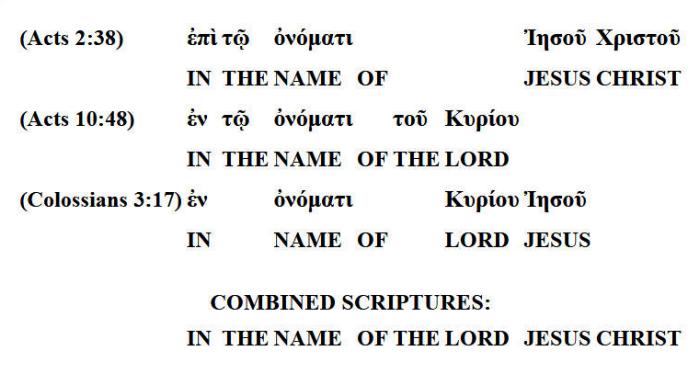
As with the previous example each of these is slightly different, and each one misses out something important that is supplied by another. The conclusion is then, that baptism should be done in the authority of THE LORD JESUS CHRIST, and this is the correct name to say when it is done.
#4.6 What about variations of this?
What about baptizing "in the name of JESUS", or "in the name of JESUS CHRIST". Are these acceptable? They will not be accepted by some for the following reasons:
(1) There have been many people named Jesus, "Jesus, which is called Justus" (Colossians 4:11), for example, and we need to be more specific about whose name we are being baptized in.
(2) The word "Christ" means "anointed one", and God's word tells us that we have all received an anointing (1 John 2:20; 2:27), so there could be several anointed men named Jesus. There are also many false christs, who declare themselves to be Christ (Matthew 24:5; Mark 13:6; Luke 21:8), and if any of these are called Jesus it could be confusing.
(3) Both of these variations show a failure to rightly divide the word of God, and have resulted in diminishing what God has commanded, which we are told not to do:
(Deuteronomy 4:2) "You shall not add to the words which I command you, nor shall you diminish anything
from it, that you may keep the commandments of the Lord your God which I command you."
(Deuteronomy 12:32) "Whatever thing I command you, observe to do it: you shall not add to it, nor diminish from it."
(4) Those who baptize "in the name of JESUS" have set up a doctrine with no scripture to support it, for nowhere was baptism ever commanded using the name of Jesus only. Those who baptize "in the name of JESUS CHRIST" have set up a one scripture doctrine (Acts 2:38), and have fallen into the same snare of the enemy as those who baptize "in the name of the Father, and of the Son, and of the Holy Spirit" (Matthew 28:19; See #3. Baptism Father Son Holy Spirit). They have therefore failed to rightly divide the word of God on this point. Both of these variations rob Jesus of his Lordship, during a process which is meant to express our submission to his Lordship over us. God's word declares that there is only "One Lord" (Ephesians 4:5), so by adding the word "LORD" to "JESUS CHRIST", we remove all ambiguity about whose name we are being baptized in, and give the full honour due to the one who died to save us. I cannot imagine why any honest Christian would argue against doing this, and refuse to baptize or to be baptized right. The use of the word "Lord", said by the baptizer, also shows that he acknowledges Jesus as his Lord, and speaks under the direction of the Holy Spirit, for "no man can say that Jesus is the Lord, but by the Holy Spirit" (1 Corinthians 13:3). Paul's habit was invariably to give Jesus his full name, "the Lord Jesus Christ", in the introduction to every epistle that he wrote (Romans 1:3; 1:7; 1 Corinthians 1:3; 2 Corinthians 1:2; Galatians 1:3; Ephesians 1:2; Philippians 1:2; Colossians 1:2; 1 Thessalonians 1:1; 2 Thessalonians 1:1-2; 1 Timothy 1:1-2; 2 Timothy 1:2; Titus 1:4; Philemon 3). Having clearly established whom he was referring to, he could then use variations of this throughout his letters without any ambiguity.
Baptism in the name of the Lord Jesus Christ bible quiz

If you have benefited from reading this study, then please tell your friends about this website.
If you have a website of your own, consider linking to this website. See the Website Links page.
Please copy and paste this bible study link into Facebook and Twitter to all your Christian friends who have not been baptized in the
name of the Lord Jesus Christ and give it a Google +.
 Baptism Father Son Holy Spirit || Full Apostolic Baptism Index ||
Bible Studies Index || Baptized into?
Baptism Father Son Holy Spirit || Full Apostolic Baptism Index ||
Bible Studies Index || Baptized into?
